


 Platform
  Payload
 The SARTO products are:
These products have the aim to offer a highly efficient, green and economical solution to system integrators of TR modules for SAR antennas. Being the HPA the most power-consuming of the RF line-up, the target is to develop a monolithic HPA, with the embedding of the driver function, leading to a huge increase of the power efficiency and a saving of up to 40% of the power consumption of SAR antennas.
This strongly increases the competitiveness of Earth observation satellites companies, which will offer a meaningful extension of the service to end users. In addition to this HPA, with the same objective of saving energy and room, a fully monolithic and very efficient HPA in X band for the data down-link is under development, in replacement of the current solution using transmitters based on vacuum tubes, like TWT, or a set of discrete solid-state components.
The main targeted customers are Earth observation satellites, specifically the SAR antennas, and airborne and ground-based AESA radar integrators.
The product provides a solution to their need of better performances, higher integration and cost reduction with respect to the actual exploited solutions.
The main end users and potential customers provided their support for the definition of the product main requirements.
The main users/customers are from Europe (Italy, France, Germany).
The product consists of a chipset of advanced High-Power Amplifier MMICs capable to provide the optimisation of the next X-band SAR Antennas for Earth observation in terms of power consumptions and encumbrances. In detail, two different monolithic circuits are proposed:
When optimised for the maximum efficiency operating point, the GaN technology selected for the proposed activity is credited to deliver an output power of about 3.5 W/mm.
Based on these characteristics, a preliminary analysis identified the following baseline architectures for the two MMICs, respectively, targeting the required levels of Output Power, PAE and Gain.
The following figures show the preliminary architectures defined for the two HPAs.
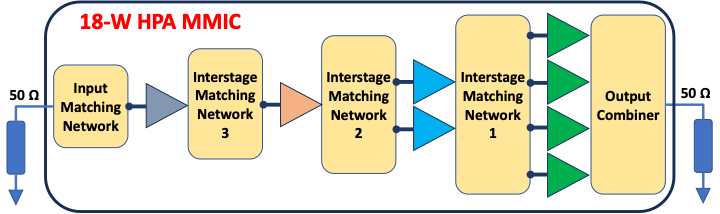
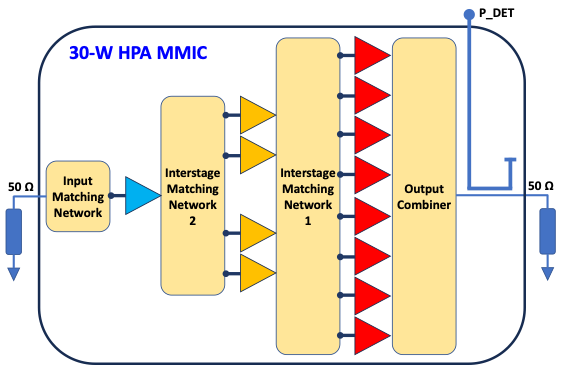
The breakthrough for both amplifiers, with respect to the current solutions, is the exploitation, at X-band, of the 0.15 µm GaN/SiC technology usually optimised for applications at 30 GHz.
The high available gain, as well as the improved efficiency and the usual high-power density level of Gallium Nitride processes, allow to reach the required output power with a very high efficiency, leading to a notable reduction of both power consumption and dissipation.
Furthermore, the well-known robustness of this technology gives the advantage to satisfy the tight reliability constraints required by space applications with limited scaling of the overall performances.
For the two specific cases, the request of the High-efficiency Amplifier comes from the need to replace 1-to-1 the MMIC currently used in the RF frontend of the X-band SAR TR modules, but with the objectives to significantly reduce the power consumption, operating with a very-high efficiency, and, at the same time, to remove the buffer amplifier now used to amplify the power at the output of the beamformer, possible by integrating in the proposed single MMIC up to 4 stages of gain.
For a direct comparison, with respect to the amplifiers used on the TR modules of COSMO-SkyMed Second Generation (CSG), the proposed solution allows twice the power (18 W) with no more than 30% of additional power consumption (33 W).
The activity is in its first preliminary phase.


 email
email  Facebook
  Twitter
  Linkedin
  Whatsapp
  Copy link
