

 Platform
  Ground Stations & Mission Management
  Data Analytics, Insights & Applications
 The request for new satellite-based observations and data management is largely dependent on centralised ground-based operations and constrained by the availability of the ground station, where data and commands are exchanged. These data are only made available for further analysis after many hours.
This limits the possibility to implement approaches such as ‘tip and cue’, since the ground segment needs to plan monitoring acquisitions, wait until the data reach a ground station, and only then process and analyse the data. In case something interesting is present in the acquisition (e.g. wild fire, dark vessel or illegal phishing), a follow-up acquisition can then be planned to gather more data, but only hours later.
The large delay between these actions limits the effectiveness of the monitoring actions. High-performance computing units and inter-satellite link connections through satellites are planned for many future constellations, and exploiting those assets will dramatically change the operational scenario: Earth observation data can be immediately processed, with AI algorithms used to extract relevant features and support autonomous decisions through AI agents, just using on-board resources and allowing an almost real-time monitoring, which would be impossible otherwise solution using transmitters based on vacuum tubes, like TWT, or a set of discrete solid-state components.
Leonardo acts as the anchor partner and reference early adopter, with direct involvement in defining the system needs and mission integration constraints, particularly in view of its future Earth observation constellation.
In parallel, Leonardo has initiated preliminary technical discussions with Satlantis (Spain) and D-Orbit (Italy):
Spain and Italy
The TASCNET product will integrate the typical capabilities of the control ground segment with autonomous capabilities allowed by the growing availability of high-performance computing resources installed on the satellite platform and the possibilities offered by AI algorithms and agents.
The main goal of the product is to migrate some of the control functionalities currently performed the ground segment to the space segment. This change allows a constellation with required capabilities to autonomously update the mission plan if specific conditions are found, enabling the possibility to implement complex scenarios, such as ‘tip and cue’, without the need of support from ground operators, greatly reducing the latency.
TASCNET combines the elements from two main components into a hybrid mission control:
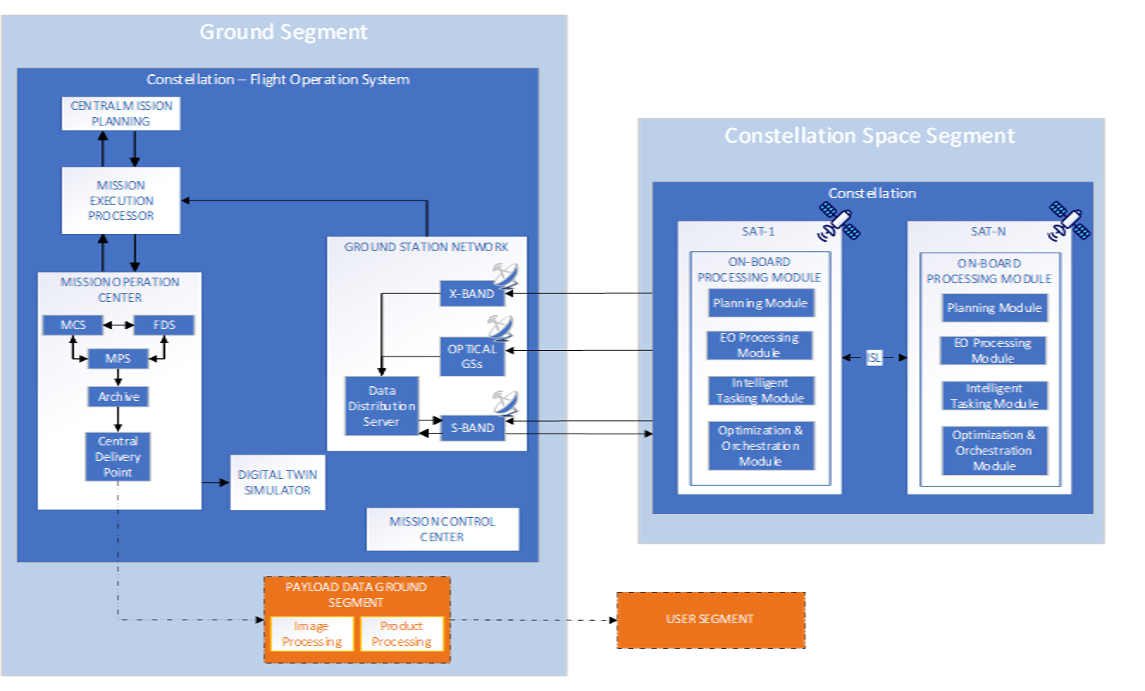
TASCNET activities focus on three main pillars:
We foresee the following main added values:
On-board EO Processing and Autonomous Planning
AI-based Mission Optimisation
Hybrid Ground Segment Adaptation
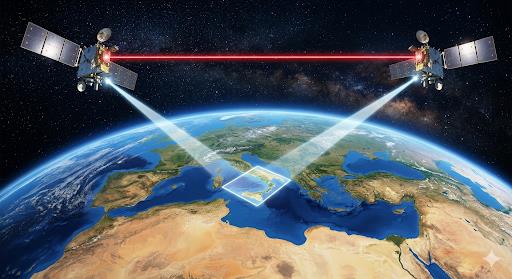
The project has started identifying the most relevant constellation characteristics that can enable added value services, such as ‘tip and cue’ without ground segment assistance, the most relevant use cases and the associated mission planning challenges. The requirements review has been successfully held, and the team is working on the preliminary design review preparation.




 email
email  Facebook
  Twitter
  Linkedin
  Whatsapp
  Copy link
